0555-6768298
0555-6768298


In sheet metal processing, the final bending accuracy of a press brake depends not only on machine rigidity (frame accuracy) and tooling quality, but also on the back gauge system, which is often underestimated as the “hidden controller” of the bending process.Essentially, the back gauge system is a high-precision positioning device that controls the feeding position of the sheet metal before bending. It directly determines the dimensional consistency of each bending edge. Without an accurate back gauge system, even the best tooling cannot guarantee stable and consistent bending results.With the increasing demand for high-precision and diversified sheet metal fabrication, press brake back gauges have evolved from traditional single-axis positioning systems to multi-axis automatic control systems, such as 3+1 axis, 4+1 axis, 6+1 axis, and even higher-axis configurations.So, what are the differences between different back gauge systems? And how should manufacturers choose the right configuration according to their production requirements?
Common Types of Press Brake Back Gauge Configurations
Currently, mainstream automatic back gauge systems can be divided into three levels:
· 3+1 Axis – Basic Configuration
· 4+1 Axis – Advanced General-Purpose Configuration
· 6+1 Axis – High-Precision Intelligent Configuration
The “+1 axis” usually refers to an auxiliary lifting axis, which is used to control finger height adjustment or avoidance movements. The main difference between different configurations lies in the number of motion axes and their control methods.
3+1 Axis Back Gauge – Economical and Practical SolutionThe 3+1 axis back gauge system consists of the X axis, R axis, Z axis, and one auxiliary axis.The X axis controls the front and rear positioning, the R axis adjusts the vertical height, and the Z axis moves the fingers horizontally as a whole. The left and right fingers move synchronously without independent adjustment.Its advantages include:Simple structure、High stability 、Easy maintenance 、Excellent cost performance ;However, because the left and right fingers cannot move independently, its flexibility is limited when processing asymmetric workpieces or products with different widths.
The 3+1 axis system is mainly suitable for standard bending applications with consistent dimensions, such as door panels, cabinet side panels, and other conventional sheet metal parts.
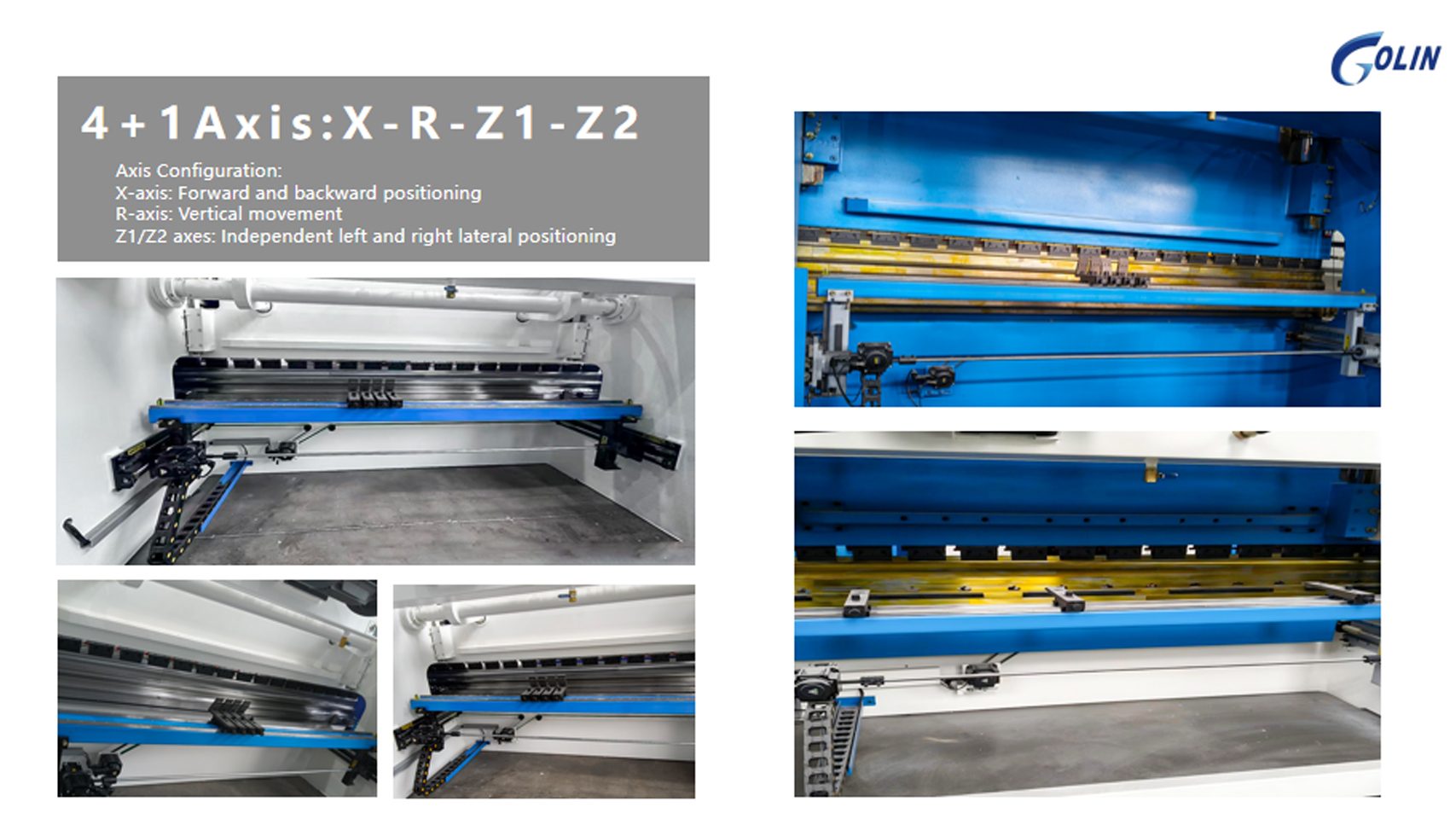
4+1 Axis Back Gauge – Mainstream General-Purpose Solution
The 4+1 axis back gauge system is currently one of the most widely used configurations. It consists of:
· X axis (front and rear positioning)
· R axis (vertical height adjustment)
· Z1/Z2 axes (independent left and right movement)
· One auxiliary axis
Its biggest feature is that the left and right fingers can be controlled independently, allowing more flexible positioning according to different workpieces.Compared with the 3+1 axis system, the 4+1 axis configuration provides better adaptability for:
· Different sheet sizes
· Asymmetric workpieces
· Multi-product production
It can significantly improve bending accuracy and production efficiency.
However, it mainly focuses on optimizing positioning within a plane and cannot perform complex spatial avoidance movements.
The 4+1 axis system is ideal for multi-variety and multi-size sheet metal production and has become a common choice for medium and large-scale manufacturing companies.
6+1 Axis Back Gauge – High-Precision Intelligent Solution
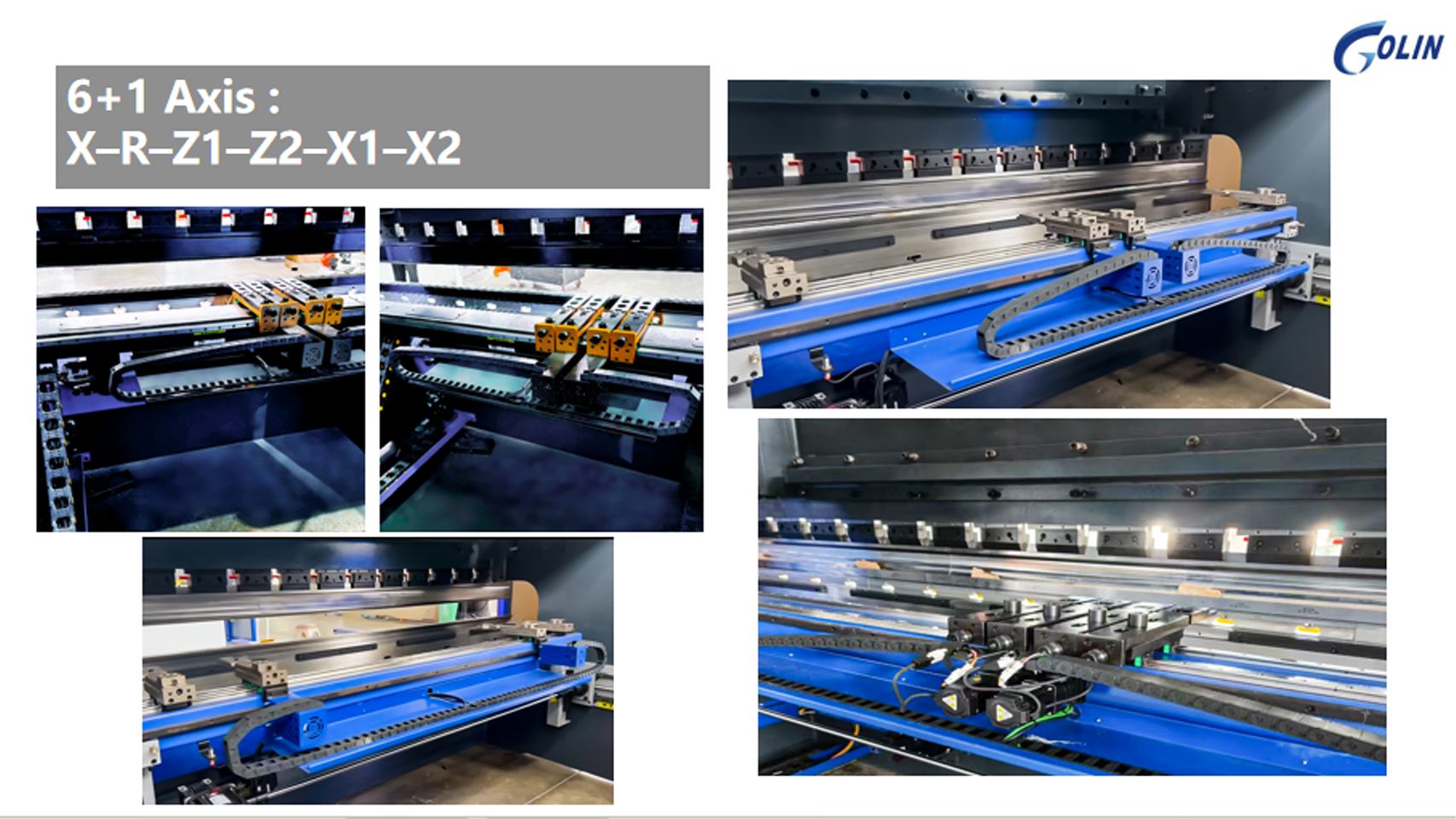
The 6+1 axis back gauge system consists of:
· X axis
· R axis
· Z1/Z2 axes
· Multiple additional auxiliary axes
Compared with the 4+1 axis system, it provides more degrees of freedom, enabling advanced movements such as finger tilting, rotation, and multi-directional fine adjustment.
Its advantages include:
· Automatic multi-directional positioning
· Effective avoidance of bending interference
· Capability for complex and irregular workpieces
· Reduced manual adjustment time
· Improved automation efficiency
However, the 6+1 axis system requires higher investment and places greater demands on programming and commissioning skills.
It is mainly designed for:
· Large sheet metal components
· High-precision parts
· Automated production lines
· Industries such as automotive, aerospace, and precision equipment manufacturing
The 6+1 axis back gauge system is an ideal solution for companies upgrading toward intelligent manufacturing and higher production efficiency.
How to Choose the Right Back Gauge Configuration?
Choosing the right press brake back gauge system requires comprehensive consideration of workpiece complexity, production requirements, bending accuracy, and automation needs. A higher number of axes does not always mean a better solution. The key is selecting the configuration that best matches your actual processing requirements.The structure and complexity of the workpiece are important factors when selecting a back gauge configuration.For standard workpieces with consistent dimensions and simple bending operations, such as door panels and cabinet side panels, a 3+1 axis back gauge system can meet basic production requirements thanks to its simple structure, high stability, and excellent cost performance.For products with frequent size variations or asymmetric workpieces, a 4+1 axis back gauge system is recommended. Its independent Z1/Z2 axes allow the left and right fingers to move separately, significantly improving positioning flexibility and adaptability.
For multi-step bending, complex shapes, or high-precision components, such as automotive parts and precision equipment components, a 6+1 axis back gauge system provides more degrees of freedom and enables more accurate spatial positioning, making it an ideal solution for complex processing applications.
Choose According to Production Requirements
Production mode and accuracy requirements together determine the ideal back gauge configuration.For mass production of single products, a 3+1 axis system is recommended due to its stable operation, simple control, and lower investment and maintenance costs.For small-batch and multi-variety production, a 4+1 axis system is more suitable. Independent left and right finger control allows quick adaptation to different workpiece sizes and reduces setup time.For production lines requiring robotic loading/unloading or intelligent automation, a 6+1 axis system provides higher flexibility and better compatibility with automated manufacturing.
In terms of accuracy requirements:
· Standard sheet metal processing → 3+1 axis
· Precision sheet metal fabrication → 4+1 axis
· High-end manufacturing applications → 6+1 axis
The higher the accuracy requirement, the greater the demand for advanced motion control capability.
Choose According to Press Brake Specifications
The working length and processing range of the press brake also influence the selection of the back gauge system.For small and medium-sized press brakes, a 3+1 axis or 4+1 axis system is usually sufficient to meet production requirements.For large press brakes over 4000mm, a 4+1 axis or 6+1 axis system is recommended to ensure stable positioning accuracy when processing large-size workpieces.
Balance Performance and Investment Cost
Although more axes provide greater flexibility, they also increase equipment costs and require higher programming and commissioning skills.Therefore, manufacturers should consider multiple factors when selecting a back gauge system, including:
· Product type
· Workpiece complexity
· Production volume
· Accuracy requirements
· Future automation plans
Only by selecting the right configuration can companies achieve the best balance between processing efficiency, bending accuracy, and investment cost.
The axis configuration of a press brake back gauge system directly affects bending accuracy and efficiency: 3+1 axis is economical and practical, 4+1 axis is suitable for most applications, and 6+1 axis is designed for high-precision and complex processing. When selecting a system, companies should consider product structure, accuracy requirements, machine specifications, production volume, and automation needs. Choosing the right configuration according to actual production conditions can improve efficiency and product quality. GOLIN provides complete 3+1, 4+1, and 6+1 axis back gauge solutions with customized options available, delivering high-precision and highly stable positioning solutions for sheet metal fabrication companies.
Please read on, stay posted, subscribe, and we welcome you to tell us what you think.


 ONLINE
 0555-6768298
 0555-6769126
 sales2@cngolin.cn
 +86 18251802252